Catholic Conference of Ohio letter on SOGI
Last week, the bishops of Ohio joined in opposing HB 369, on “sexual orientation” and “gender identity” with a letter to state legislators.
Archive
Press Release: USCCB Bishop Chairmen Commend Administration Action
WASHINGTON—Bishop Frank J. Dewane of Venice, Chairman of the Committee on Domestic Justice and Human Development, Bishop James D. Conley of Lincoln, Chairman of the Subcommittee for the Promotion and Defense of Marriage, and Bishop Robert J. McManus of Worcester, Chairman of the Committee for Religious Liberty, have issued a statement commending a proposed rule change that will help ensure faith-based social service providers will not be excluded from certain federally-funded programs at the U.S. Department of Health and Human Services (HHS).
Their joint statement follows:
“We commend the Administration for acting to change a 2016 regulation that threatened to shut out faith-based social service providers, namely adoption and foster care agencies that respect a child’s right to a mother and a father. To restrict faith-based organizations’ work by infringing on religious freedom – as the 2016 rule threatened to do – is unfair and serves no one, especially the children in need of these services. We are alarmed and saddened that state and local government agencies in multiple jurisdictions have already succeeded in shutting down Catholic adoption and foster care agencies as a result of their Catholic beliefs. At a time when over 400,000 children are in foster care, we need to take steps to increase – not decrease – their opportunities to be placed with safe and loving families. We welcome today’s proposed rule modifications and look forward to reviewing and commenting on them further.”
Archive
Made for Love Ep 48: When a Loved One is in Prison, Part Two
When someone comes out of prison, what does the Church do to help them pick up their lives again? Today we’ll talk with Bishop Wack from the Diocese of Pensacola-Tallahassee and Fr. Dustin Feddon, of Joseph House, Angela Burrin, who ministers at a Maryland women’s prison, and Lindsay Myers.
Here’s a website about Catholic Prison Ministries.
On Podbean:
And Soundcloud:
Archive
USCCB Chairmen Issue Statement on Supreme Court Cases on Redefinition of “Sex” in Civil Rights Law
October 8, 2019
WASHINGTON— Bishop chairmen of three committees of the United States Conference of Catholic Bishops (USCCB) commented on three cases argued before the Supreme Court today – Bostock v. Clayton County, Ga., Altitude Express v. Zarda, and R.G. & G.R. Harris Funeral Homes v. Equal Opportunity Employment Commission. These cases present the question whether the prohibition on employment discrimination based on “sex” in Title VII of the Civil Rights Act of 1964 includes “sexual orientation” and “gender identity” discrimination, respectively.
Bishop Robert J. McManus, of Worcester, Chairman of the Committee for Religious Liberty, Bishop Frank J. Dewane, of Venice, Chairman of the Committee on Domestic Justice and Human Development, and Bishop James D. Conley, of Lincoln, Chairman of the Subcommittee for the Promotion and Defense of Marriage, issued the following statement:
“Today the U.S. Supreme Court heard oral argument regarding the meaning of the word ‘sex’ in federal law. Words matter; and ‘sex’ should not be redefined to include sexual inclinations or conduct, nor to promulgate the view that sexual identity is solely a social construct rather than a natural or biological fact. The Supreme Court affirmed that sex is an ‘immutable characteristic’ in the course of establishing constitutional protections for women against sex discrimination in the 1970s. Such protection is no less essential today. Title VII helps ensure the dignified treatment of all persons, and we as Catholics both share and work toward that goal. Redefining ‘sex’ in law would not only be an interpretive leap away from the language and intent of Title VII, it would attempt to redefine a fundamental element of humanity that is the basis of the family, and would threaten religious liberty.”
On August 23, the USCCB filed amicus curiae briefs in the cases, available at http://www.usccb.org/about/general-counsel/amicus-briefs/upload/Bostock-8-23-19.pdf and http://www.usccb.org/about/general-counsel/amicus-briefs/upload/Harris-8-23-19.pdf
In addition, staff prepared a backgrounder on the cases.
Archive
Arizona Catholic Conference on Brush & Nib Decision
The Arizona Catholic Conference (all the bishops of dioceses in Arizona) published the following statement in response to the Arizona Supreme Court decision in favor of Brush & Nib Studios:
We are grateful that the importance of religious liberty was recognized today by the Arizona Supreme Court in the case of Brush & Nib Studio v. City of Phoenix.
The case involves two Christian artists who only want to create art that is consistent with their artistic and religious beliefs. Today’s ruling striking down a Phoenix law that had threatened their ability to do so by potential government coercion is, therefore, a positive development for religious liberty. After all, the freedom to practice one’s religion is fundamental to our way of living and should never be reduced to a “freedom of worship” that limits these rights to the confines of church property.
As we have stated previously, the Catholic Church supports the human dignity of people of all faiths, and even those of no faith, while firmly opposing any forms of unjust discrimination. We consider ourselves blessed to live in a county that values such freedoms and respect for all people.
Thankfully, the reality still remains that Arizona has the ability to serve every person while making room for valid conscientious objection for the purposes of religious freedom.
Accordingly, we applaud today’s ruling in the Brush & Nib case as a positive step forward in recognizing these inalienable rights.
Most Rev. Edward J. Weisenburger
Bishop of Tucson
Most Rev. Thomas J. Olmsted
Bishop of Phoenix
Most Rev. Eduardo A. Nevares
Auxiliary Bishop of Phoenix
Most Rev. James S. Wall
Bishop of Gallup
Archive
USCCB Chairmen Applaud Proposed Regulations
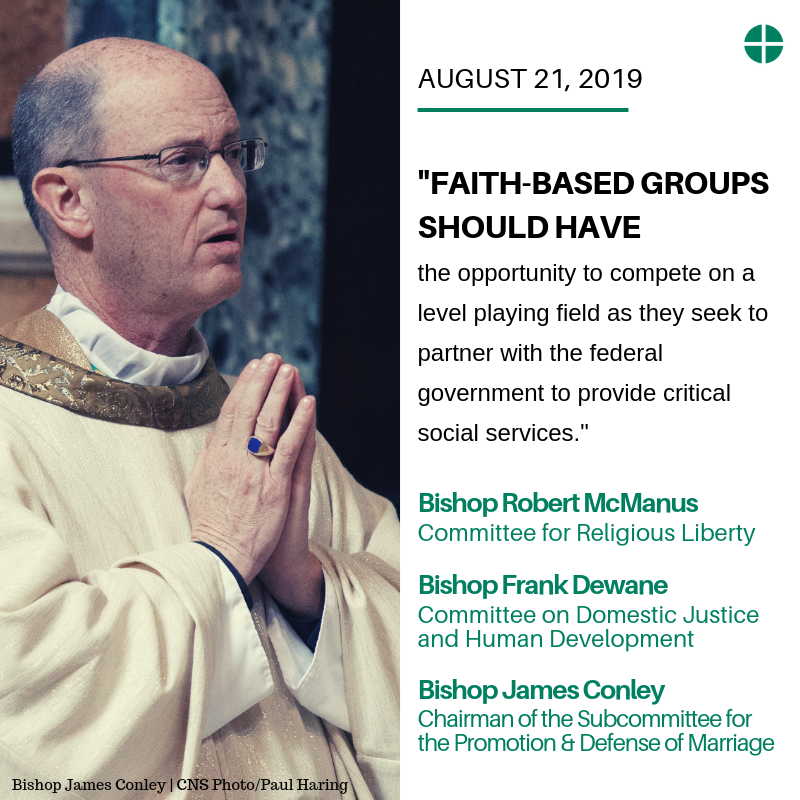 Recently, the Administration offered proposed regulations that would prevent government discrimination against faith-based federal contractors. Three USCCB Chairmen issued the following statement:
Archive
Made for Love Ep 42: The Power of Music
Do you have a favorite hymn? Do your kids settle down at Mass when they hear the music? On this episode, Bishop Berg of Pueblo, CO and Archbishop Sample of Portland, OR talk about the power of music to raise the soul to contemplate God.
On Podbean:
And Soundcloud
(Or wherever you get your podcasts!)
Archive
Male and Female He Created Them
On June 10, 2019, the Vatican Congregation for Catholic Education released a reflection on human sexuality entitled: ” ‘Male and Female He Created Them’: Towards a Path of Dialogue on the Question of Gender Theory in Education”
The document is the fullest exposition of the concept of gender (gender identity, gender fluidity, ‘transgenderism,’ etc.) that has been released from the Vatican to date. It is concerned with the “educational crisis… in the field of affectivity and sexuality” (no. 1) and reiterates Catholic anthropology, rooted in Sacred Scripture and Tradition. “The Christian vision of anthropology sees sexuality as a fundamental component of one’s personhood” (no. 4).
The document seeks to combat the dualism that is operative in the idea that “one’s gender ends up being viewed as more important than being of male or female sex. The effect of this move is chiefly to create a cultural and ideological revolution driven by relativism, and secondarily a juridical revolution, since such beliefs claim specific rights for the individual and across society” (no. 20). This is precisely what legislation such as the Equality Act does.
There will be further reflection on this document in the coming days and weeks, so watch this space!
And here’s a reminder of a few resources that the USCCB has created or made available on the issue of gender:
Gender Ideology: Select Teaching Resources
Created Male and Female: An Open Letter from Religious Leaders (December 15, 2017)
Archive
Seek the Lord Column by Archbishop Schnurr
Archbishop Dennis Schnurr, of the Archdiocese of Cincinnati, reflected on May 31, 2019 on the state of religious freedom in our country in his column in The Catholic Telegraph. He writes,
“In the United States, freedom of worship is taken for granted. However religious liberty involves much more than that. It is also the freedom to live out our faith in the public square as we serve the community in faithful citizenship. That is what the First Amendment to the U.S. Constitution protects in its very first words: ‘Congress shall make no law respecting an establishment of religion, or prohibiting the free exercise thereof.’
Today, however, Catholic hospitals, schools, and charitable services (such as adoption and foster care) are under attack for upholding Catholic teaching about marriage and sexuality. New federal legislation introduced in the House of Representatives, deceptively called the “Equality Act,” would force such institutions to choose between operating according to our faith and shutting down. This is the latest in a series of threats to religious freedom over the past decade.
The Catholic Church in the United States will highlight these challenges later this month with its annual observance of Religious Freedom Week. The week begins with the Feasts of St. Thomas More and St. John Fisher on June 22 and ends with the Feast of Sts. Peter and Paul on June 29. All those saints were martyred for living their faith – the faith we share as Catholics.”
Join in the USCCB’s observance of Religious Freedom Week, 2019!
Archive
Bishop Olmsted at the National Catholic Prayer Breakfast
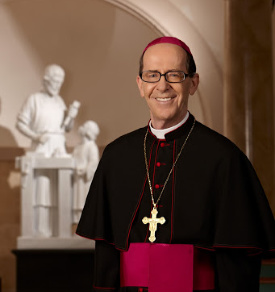
Bishop Olmsted of the Diocese of Phoenix spoke at the National Catholic Prayer Breakfast on April 23, 2019. His full address is available; He spoke on the importance of continuing to preach the good news of marriage and family.
He spoke about gender ideology, among other topics, noting, “Any rejection of bodiliness will immediately target two beautiful but demanding and sometimes inconvenient realities: marriage and the child.”
Archive
Made for Love Ep 34: Addiction and the Family
How do Catholic families navigate the waters of addiction to drugs or alcohol? How can the Church better support recovery efforts? On this episode, hear from two men in recovery, Dan Buckley and Brian Peck, who were interviewed by Zoey Maraist at the Arlington Catholic Herald, and Bishop Burbidge in the Diocese of Arlington who has many ideas for the Church’s ministry to families dealing with addiction. We also talk with Nina Marie Corona, who experienced the heartache of watching her daughter struggle with addiction and who is certified in alcohol and drug recovery and began the programs “We Thirst” and “Afire.”
Read Zoey Maraist’s story from the Arlington Catholic Herald, “The opioid crisis is ‘a family disease'” and meet Dan and Brian. Check out their podcast— that’s where this audio came from!
I also just realized– Sara, here– that I missed an opportunity to introduce y’all to the Venerable Matt Talbot in this episode! He struggled with alcoholism, and today people ask for his intercession to become sober. I was able to see his Shrine in Dublin when we attended the World Meeting of Families last summer. Outside the shrine, people had written in chalk their names and their lengths of sobriety.
On Podbean:
And Soundcloud:
Archive
Bishop Olmsted: Complete My Joy
Bishop Thomas J. Olmsted of the Diocese of Pheonix has published a new apostolic exortation on the family: Complete My Joy. Check it out!
Archive
Made for Love Ep 24: Young People in the Church
As the bishops of the Church discussed during last month’s synod in Rome, we here at home are discussing young people, the faith, and discernment with Bishop Caggiano of Bridgeport (also a delegate to the synod), Bishop Sis of San Angelo, Sr. Helena Burns, fsp, Anna Carter of the Eden Invitation, and 3 young people: Jeanne Marie Hathway, Kelly Walsh, and Elizabeth Plaza.
Listen on Soundcloud:
Or Podbean:
And here are a few resources about discernment (including consolation and desolation, as mentioned in the episode):
USCCB:
- Discernment Tools
- Resources for Parents on Vocations
- Vocation Videos
- Parish Vocation Resources
- Campus Ministry Vocation Resource
Other
(Not endorsed! Just Sara’s googling and a cursory check that it’s not crazy…)
- Introduction to Discernment of Spirits
- Fr. Timothy Gallagher’s Podcast and Website on Discernment of Spirits (Author of Discerning the Will of God and many other books on this topic.
Archive
Made for Love Ep 14 Fatherhood: the Masculine Genius
Fathers are a gift to their children. Fatherhood is also an immense task; a father is meant to give unconditional love and acceptance, along with protection and challenge. This episode features Bishop Sis (San Angelo), Bishop Paprocki (Springfield), Mark Hartfiel of That Man is You, Paul Jarzembowski and Andy Lichtenwalner from the USCCB, Katy Doran of CanaVox, Deborah Savage from the University of St. Thomas, and Joseph Capizzi from Catholic University.
Links to some of my guests’ organizations:
That Man Is You from Paradisus Dei
CanaVox
And as always, the episode is also on Soundcloud and iTunes (USCCB Clips)!
Archive
Marriage is a Share in the Plan for Creation
Check out Bishop DiMarzio’s column on marriage in his Diocesan paper (Diocese of Brooklyn).
Archive
USCCB Chairmen Applaud Supreme Court’s Respect for Religious Liberty in Masterpiece Cakeshop Decision
WASHINGTON—Today, the U.S. Supreme Court decided the case of Masterpiece Cakeshop v. Colorado Civil Rights Commission. The case involves a Christian baker named Jack Phillips who declined in 2012 to create a custom wedding cake for a same-sex ceremony. State officials sought to compel Phillips to create such cakes under Colorado’s public accommodations law. The Supreme Court ruled 7-2 in favor of Phillips under the Free Exercise Clause of the First Amendment to the U.S. Constitution.
Archbishop Joseph E. Kurtz of Louisville, Chairman of the Committee for Religious Liberty, Archbishop Charles J. Chaput, O.F.M. Cap., of Philadelphia, Chairman of the Committee on Laity, Marriage, Family Life and Youth, and Bishop James D. Conley of Lincoln, Chairman of the Subcommittee for the Promotion and Defense of Marriage of the U.S. Conference of Catholic Bishops (USCCB), issued the following joint statement:
“Today’s decision confirms that people of faith should not suffer discrimination on account of their deeply held religious beliefs, but instead should be respected by government officials. This extends to creative professionals, such as Jack Phillips, who seek to serve the Lord in every aspect of their daily lives. In a pluralistic society like ours, true tolerance allows people with different viewpoints to be free to live out their beliefs, even if those beliefs are unpopular with the government.”
The USCCB filed an amicus curiae brief supporting Masterpiece Cakeshop, which can be found here: http://www.usccb.org/about/general-counsel/amicus-briefs/upload/16-111-tsac-USCCB.pdf.
Archive
Made for Love Ep 13: Priests Come from Families too, You Know
When a man decides to go to the seminary, his family’s reaction matters. In this episode, two bishops (Bishop Caggiano, Bishop Rassas), 2 priests (Fr. Al Baca, Fr. Luke Ballman), and 1 seminarian (Brendan Glasgow) share their parents’ reaction to their discernment.
The above link is for Podbean, which is a platform we joined because we got feedback that it is better for a lot of people. But everything is still on Soundcloud and iTunes too!
Archive
Oklahoma Bishops Praise Protections for Adoption Agencies
The Governor of Oklahoma recently signed into law a bill that protects faith-based adoption and foster care agencies that continue to hold that children deserve to be placed in homes with both a mother and a father. The Bishops of Oklahoma have praised this upholding of religious freedom in the state.
Archive
Archbishop Wenski: Church’s defense of marriage not based on ‘hate’
Archbishop Thomas Wenski of the Archdiocese of Miami recently published this article on the Church’s defense of marriage. It is also available in Spanish.
This is a great reminder that the Church’s defense of marriage as the union of one man and one woman has not ended because of the Supreme Court’s redefinition in 2015.
Archive
Masterpiece Oral Argument Today at SCOTUS
Today the USCCB gave this press release about the Masterpiece Cakeshop case that was heard today at the U.S. Supreme Court:
USCCB Chairmen Comment on Supreme Court’s Oral Arguments on Religious Freedom of Creative Professionals
WASHINGTON—Today, the U.S. Supreme Court heard oral arguments in the case of Masterpiece Cakeshop v. Colorado Civil Rights Commission. The case involves a Christian baker named Jack Phillips who declined in 2012 to create a custom wedding cake for a same-sex ceremony. State officials seek to compel Phillips to create such cakes under Colorado’s public accommodations law. Phillips argues that the state’s action against him and his bakery violates the Free Speech and Free Exercise Clauses of the First Amendment to the U.S. Constitution.
Commenting on the oral arguments before the Court, Archbishop Joseph E. Kurtz of Louisville, Chairman of the Committee for Religious Liberty, Archbishop Charles J. Chaput, O.F.M. Cap., of Philadelphia, Chairman of the Committee on Laity, Marriage, Family Life and Youth, and Bishop James D. Conley of Lincoln, Chairman of the Subcommittee for the Promotion and Defense of Marriage of the U.S. Conference of Catholic Bishops (USCCB), issued the following joint statement:
“Today’s oral arguments address whether our Constitution’s guarantees of free speech and freedom of religion will be protected by the Supreme Court. Americans of every creed depend on these guarantees of freedom from unnecessary government coercion. America has the ability to serve every person while making room for valid conscientious objection. We pray that the Court will continue to preserve the ability of people to live out their faith in daily life, regardless of their occupation. Artists in particular deserve to have the freedom to express ideas—or to decline to create certain messages—in accordance with their deeply held beliefs. Justice Anthony Kennedy acknowledged in the Obergefell decision in 2015 that people who oppose same-sex marriage ‘reach that conclusion based on decent and honorable religious or philosophical premises.’ Creative professionals should be allowed to use their artistic talents in line with these decent and honorable convictions.”
The Supreme Court is expected to issue a ruling by the end of June.
The USCCB filed an amicus curiae brief supporting Masterpiece Cakeshop, which can be found here: http://www.usccb.org/about/general-counsel/amicus-briefs/upload/16-111-tsac-USCCB.pdf.
—